Expanding it, you're saying "If you can't self-sustain your residence from within an arbitrary municipal boundry, it's your own fault if others won't pipe water to you".
That's just not how the world should work. Every major city in the country gets its water and power from other areas outside their town boundry.
I just looked up where my water supply is sourced from, and it's 30 miles. I don't live in a desert, or anything close to it.
I presume you feel the same about power? Again, I looked up my closest major power source, and it's a nuclear plant about 30 miles away the other direction.
My parents, less than an hour from where I live, the center of Atlanta, have well water. They live on a street that no ISP will service, unless you consider <50KBps and 50% packet loss for 60 dollars a month reasonable, if it decides to connect at all that day.
They don't have natural gas lines either. Or sewer lines. You'd be quite surprised how things still are in some places.
I live in upstate NY, USA. Lots of people have well water and septic tanks around here. Growing up in NH, USA lots of people there had wells and septic tanks, too.
I seriously doubt there's enough well/aquifer water in the US to sustain the entire US population for very long. As I understand it, many aquifers are being depleted right now and/or at serious risk of salination due to over usage. If you moved everyone else who gets their water from reservoirs to well/aquifers, there would be no chance.
Right, and the other side of that is that cities couldn't exist at all if we relied on well water alone. There isn't enough concentrated in one place, even if it were clean enough to avoid continuzous cholera outbreaks. Even in relatively wet parts of the country. New York for instance uses billions of gallons daily, piped in from upstate - and has had to for over a hundred years.
The point isn't that the area can't supply its own water, nor that upstate NY can't supply enough water for NYC. The point is that even in a water-rich region, a city like NYC (or even one the size of Albany) cannot support its population off well water. Thus the existence of modern economic centers is dependent on piping in water. Telling city dwellers that they should get their water from wells so as to avoid dependence on their neighbors for their water is an absurdity.
In terms of locally-available water, it really pretty much is. As is almost all of the U.S. starting a couple hundred miles west of the Mississippi River and the Pacific, the Northwest excepted.
San Francisco itself has next to no indigenous lakes or (fresh)waterways. Lake Merced, Laguna Honda, and Mountain Lake. A handful of springs. Already in the 19th century, water was in limited supply and brought in from the Peninsula. Much of San Francisco (the Richmond and Sunset districts) were sand dunes. The part that wasn't was in large part wetlands (Marina, Financial District, SoMa, Bayview).
Rainfall ranges from about 12 in (30 cm) in a dry year to about 30 in (75 cm) in wet, but that's strongly concentrated in the winter months, meaning you need a large amount of water storage for the summer (and, again: no lakes).
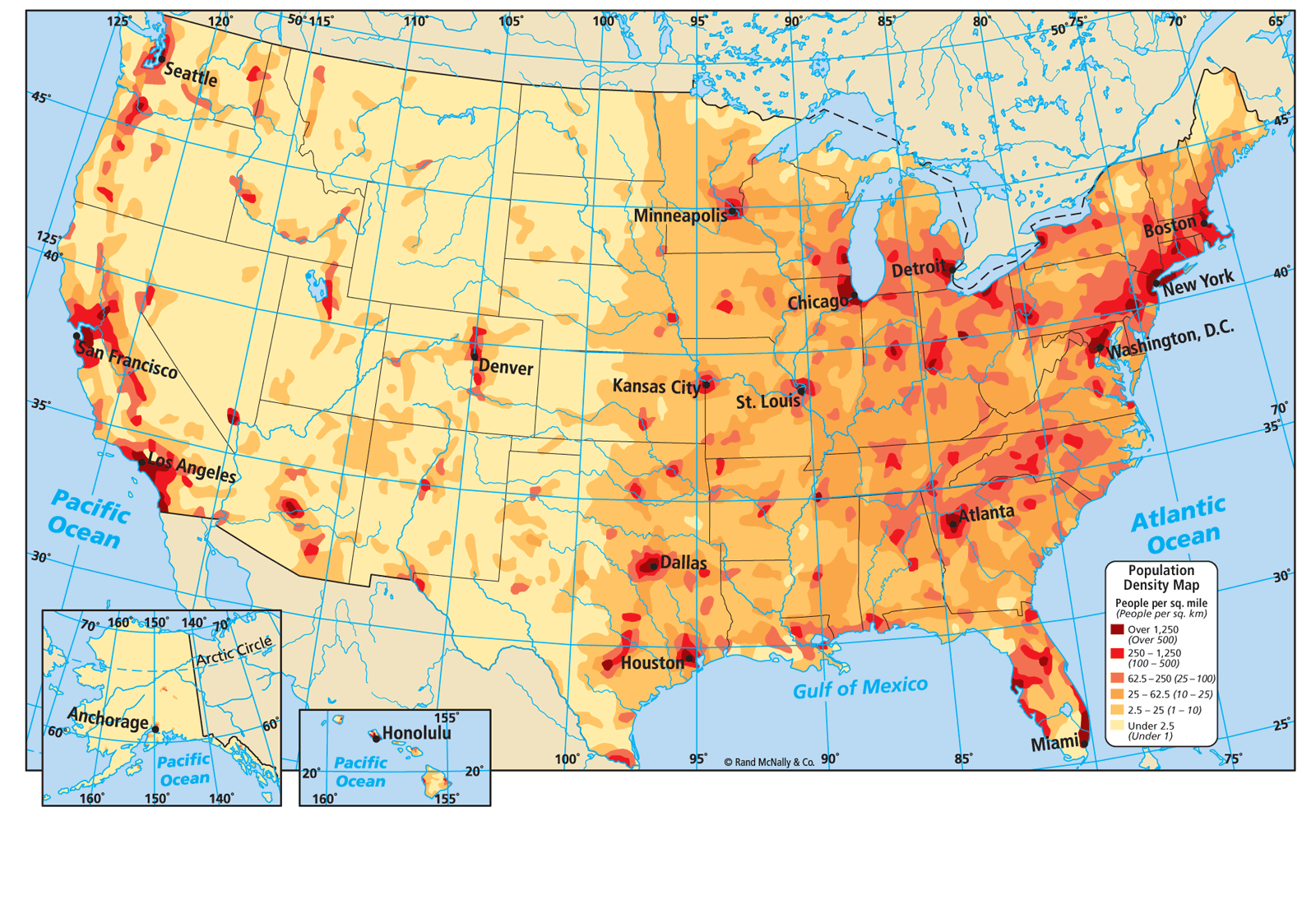
If you look at a population density map of the U.S., or one with higher levels of detail showing urbanisations, you note that the pattern devolves from very regular in the east to almost a desert-island scattering in the west. Much of that is accounted for by water availablility, and the water shadow of cities. Look at the map below, which shows the Colorado River, and realise that Los Angeles's watershed reaches very nearly to Denver. In many ways, it is effectively preventing any other cities from emerging throughout that region (not that several haven't tried).