There are many beach cleaning machines. A medium-sized robotic one.[1] A large one that Virginia Beach uses to clean up after spring break.[2] As with agricultural equipment, self-contained robots tend to lose out to wide implements towed behind tractors.
Nobody vacuums sand to clean it. Sand is scooped up, screened, and returned to the ground.
Here's a video of a wide variety of beach cleaning machines.[1]
Some of those have big messes to clean up, with rocks, seaweed, and storm debris.
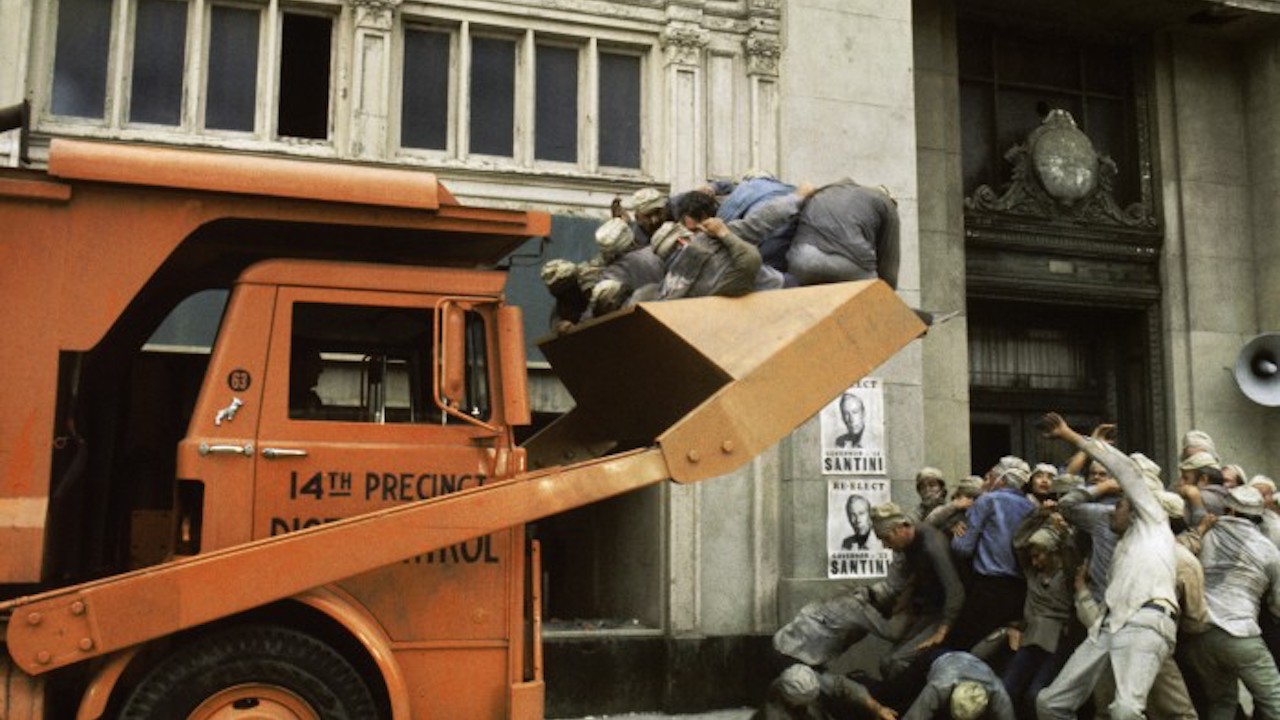
Dump trucks are sent out to service the larger beach cleaners, like a harvesting operation.
If you need beach cleaning machines, it's usually because you have a lot of stuff to remove.
I was talking that many machines...sorry robots don't need legs and your links show that. To make a legged robot that can "suck" one piece (specialized in Cigarette butts) with it's legs is incredible stupid.
In theory there exists a crossover point, right? Tractors scale somewhere like O(x^2) to O(x^3) in costs as the implements get wider by a factor of x, depending on exact design decisions, and swarms of robots scale out somewhere like O(x). Tractors have been getting bigger (trying to get more work done for the same amount of human labor), and if that trend continues you'd expect some sort of smaller, swarm solution to be viable (be it on the larger end, small automated tractors, or smaller still where you can take advantage of local sensors and automate something like weeding instead of paying for herbicides and that particular flavor of special seeds).
The optimal size for tractors is more a function of the topology of the land and the soil type than $/acre spent on the equipment.
In theory, the minimum feasible unit of equipment should be a lot smaller for sand than dirt (less weight is required to break up the sand), and beaches tend to be curved and bumpy, so that favors a swarm of small robots.
However, the cost of maintaining the swarm is linear in swarm size, but the cost of maintaining one tractor is sublinear in tractor size. I'd guess it's roughly as difficult (within a factor of 2-10x) to unclog up the sand sifter on a beach combing tractor as it is to unclog the analogous component on a single swarm robot. At 10x, that suggests a swarm of over ~ ten robots is infeasible (unless they are self-repairing and self-maintaining).
The article mentions places where wheeled devices can't reach (stairs, steep beaches). I'm guessing that'll be the main use case for these things.
As for precision herbicides + planting, I suspect that's better done with special tractor attachments that have fine grained control over each row's implement. Most stuff is grown in large fields and GPS guided tractors are getting more common.
As far as I can tell, your position is something like:
(1) People only use bigger tractors for worse soil, not to reduce their own human workloads. This caps the natural progression of machine sizes I'm describing, thus stopping things before a size where swarms matter (not refuting a crossover point (kindly consider the O(x^2) or greater vs O(x) cost idea), but suggesting we'll never reach it).
(2) The human cost of maintenance dwarfs all other costs, and the status quo of small vs large machines suggests large machines will be cheaper to repair, so a swarm of 1-2 big machines will be much cheaper to repair than 100-200 small machines.
(*) some addendum addressing my less important side-benefits
There are small beach cleaning machines, down to push-broom sized devices used for cleaning beach volleyball courts. The beaches that need regular cleaning are usually big, heavily used public beaches, where a large machine is effective.
I am always skeptical about using small machines if big machines can do the job as it is the case with farming, but also energy production, transport, etc...
For tractors, most modern "big" tractors already do most of the work automatically. The guy in the cabin is mostly there for supervision and dealing with the unexpected. And later, for maintenance. Swarms won't help, quite the opposite in fact: more supervision, more unexpected situations, more hardware to maintain... Better automation can help, but better automation will help big machines too.
Weeding could potentially be done by an wide array of sensors and picker arms, pulled by a tractor, and maybe followed by a large collector. This way, there is no need to have a propulsion and power system for every picker, the tractor will provide this.
Sometimes, small machines make sense but the general trend is towards bigger, it the technology allows it.
And in many cases, it is sublinear. A semi-truck costs much less per ton than a van. Fright trains are even cheaper. And container ships, even less so. In fact, I am convinced that it is sublinear for tractors too, but the benefits go to John Deere rather than to the customer: bigger tractors offer more value to the customers who have a use for them, so they can increase their prices accordingly.
Working in tech, you should know that the list price of an item is a poor proxy for how much work and how many raw materials went into it. When you don't have very many brand choices, market dynamics matter quite a bit. I think it's noteworthy that those same tractors increase in weight superlinearly with horsepower.
Let's assume price is a good enough proxy metric though:
> HP should be a decent approximation for the amount of work done.
The problem is that the amount of work done, measured in energy at the tractor, isn't a good approximation of the amount of work done, measured in useful effects on the farmland (stated differently, wider implements are less efficient). If you look at what width of tiller or other implement you can pull behind those tractors, it scales poorly with horsepower, and when you read through case studies of people who tried to get away with smaller tractors and wider implements you find that they had a lot more human toil and more passes over the farmland to make them work.
A more useful proxy metric would be how many dollars of tractor a single person needs to manage X acres of farmland (for any fixed task) in Y hours. That's a little hard to gather data on because you have qualitative shifts in who's farming for which reasons as you increase acreage, but if you look at the actual tractors' capabilities (e.g., appropriate width of implements) you can compute it as a derived metric.
> comparison to trains, semis, ...
The comparison isn't great. The whole point of a tractor is to manipulate its environment, immediately spending energy to break physical bonds in plants, accelerating and decelerating a rock from point A to a nearby point B, .... Mechanisms of transport get around that because the only "mandatory" costs are the delta-v: accelerating and decelerating the load. If you're transporting a long distance, that's a negligible fraction of the costs, and all you're doing with scale is reducing the drag along the way. Since drag is nearly proportional to frontal surface area in common speed/weight regimes, you get the observed effect that a longer vehicle (a van or a semi) is more efficient per unit of load than a shorter vehicle (with extra benefits because the shape itself has less drag per unit of frontal surface area). As you scale to something like a train, rolling resistance matters a lot more. The extra efficiencies there are basically because your steel wheels don't deform as much as rubber wheels, and more of that deformation is reclaimable (with many other benefits, e.g., you're able to waste less weight on the engine relative to the load).
The key feature making that possible though is transport over long distances, amortizing the cost of startup and shutdown, with a secondary important feature being low rolling resistance pathways (roads, bridges, rails, cargo ships with the barnacles cleaned off, ...). Farms have neither of those. Loose dirt is piss-poor rolling resistance characteristics, and the bulk of the work you're doing is severing physical bonds to move things a few inches or feet. The "work" being done is the whole point of the activity, rather than a byproduct you're able to minimize.
Looks to me like this is an innovation fund project which demonstrates a cool idea. Most of the comments here are complaining about practical issues but I don’t believe running this thing all day long on a public beach is the primary goal.
I’m not sure whether it is the press coverage that implies that this is a highly practical solution, or if the actual makers claim that too. But I look at it as a clever maker hack, not a commercial product which should be picked apart as flawed.
> but I don’t believe running this thing all day long on a public beach is the primary goal.
So it will create more waste than it will ever dispose of.
> not a commercial product which should be picked apart as flawed.
This is hacker news. It does not matter if your product is "commercial" or not. If it has flaws, they will be discussed here, we are not obligated to be cheerleaders for ideological solutioneering.
I hate splitting / magic bullet fallacies as much as the next guy, but the problem with these sorts of efforts is that they re-cast public perception of who is responsible for creating the problem, taxing the producers/consumers to pay for the costs they are incurring to society so that it is not economically feasible to produce "disposable" materials that never break down, getting them to stop, and holding them responsible for cleanup.
They're also completely insignificant, and actually make the problem worse, because it addresses the problem where people see it, which is a tiny, tiny fraction of the total problem.
Same with the highly publicized "man cleans up _____ and collects ___ bags of trash at park/beach, yay humanity!" stories. Media are pushed by plastics companies to cover these "feel good stories" because it implies that the problem can and should be addressed by citizen efforts like that. "Why if we all did that, we'd solve plastic pollution" seems to be the problem. It also sort of implies that if we had a lot more people like Mr. Good Guy Greg Litter Remover, the problem would be solved - when plastic is distributed pervasively through the entire ecosystem.
Can't clean up the millions of tons of plastic floating at all levels of the ocean, sitting on the ocean floor, in the stomachs of marine wildlife, etc.
This robot dog is like driving half-way across the country to spit on a wildfire and then calling up a bunch of news stations to tell them how you helped.
Not to mention all the resources consumed building the stupid thing that could have gone towards carbon and greenhouse gas reduction. Really, this is just some CS / robotics lab's vanity project.
It is possible to dramatically reduce littering. Singapore has strict littering punishments. You don’t see a lot of litter on the ground. Of course caning people for littering isn’t a very popular policy in most countries.
But in Singapore they also pay people to sweep the streets, because despite the laws, trash still will accumulate. Note that Singapore also doesn’t have a minimum wage which means people can be paid a low amount to clean the streets.
In the U.S. we don’t enforce littering laws, and we also mostly don’t pay people to sweep streets. So we have very dirty streets.
What a robot can do is work for very low cost to clean up streets. Far below minimum wage.
If I'm going to assume that most babies, some children, and a few third world people do not smoke at all, and round it down to 3.5 billion smokers alive in the world today, you're saying that every single smoker throws 3 cigarettes into the ocean (just the ocean, not counting landfills) every single day?
"So, this is about a lot more than cigarette butts, and the researchers suggest a variety of other potential use cases, including spraying weeds in crop fields, inspecting cracks in infrastructure, and placing nails and rivets during construction."
How do the sifting machines differentiate between cigarette butts and little sticks/rocks/pieces of driftwood &c?
If this dog vacuum thing is not too noisy and can unobtrusively navigate an area it seems like it might be a pleasant "always on" addition. I used to work a maintenance job where I'd show up at 1am and sweep up dozens of cigarette butts from the parking lot. Then I'd pop back out around dawn and there'd be a dozen new ones! It really is a constant and ongoing issue.
Perhaps the robot could monitor the area for active smokers and just go over and offer up an ash tray.
I'm a person who never throws cigarette butts, chewing gums, or shit with my dog all over the place. This is an entire domain of problems and solutions which shouldn't even exist.
True. It's the same with projects like 'The Ocean Cleanup'. In Mainland China there's an army of underpaid elderly street sweepers earning basically nothing (2k RMB/month), who constantly clean up after folks mindlessly dropping their trash on the streets. Or take the craze around drugs like semaglutide (Ozempic) in the West. Technologists constantly come up with solutions that directly or indirectly support immoral behavior and unsustainable lifestyles.
I'm not saying let's not have robots cleaning up. But first of all, before we look to such solutions, litterers should be fined to high heaven. Make it sting, so that these people don't even think about doing it anymore. Make it day fines, based on the person's income. They will learn to keep beaches clean that way.
> Or take the craze around drugs like semaglutide (Ozempic) in the West. Technologists constantly come up with solutions that directly or indirectly support immoral behavior and unsustainable lifestyles.
Why the dig at obesity?
If there's anything we are learning from GLP-1 medications, it is that, for many, weight control is not a moral failing. Many of these people will have spent thousands on coaching, gyms, nutrition plans, counselling, and any other option to try to lose weight the 'hard' way. Literal blood sweat and tears. Statistically, those interventions don't work well in the long term. Plenty of the morally unimpeachable suffer from weight issues. Clearly there is a physiological component as well. This medication treats it.
Is it also a moral failing to take a Tylenol to treat a hangover headache instead of suffering through the pain until it goes away? Maybe surgery patients should just tough it out, without anesthesia like they used to in the 1800s instead of taking the easy way out?
People are treated for 'self-inflicted' physical issues constantly. Why are you picking on overweight ones?
Ozempic was approved in the US for treatment for type 2 diabetes, but over a third of users are taking it off-label, they have no history of diabetes¹. Of course one can phrase it in a way that makes it sound like they're suffering from a disease and are getting the "medication" they need. Would you say the same about folks using benzos off-label though?
We use positive language (medication) or negative (drug abuse) depending on the picture we want to paint. The point is these are examples of things that shouldn't exist, because for most of us who're healthy and able bodied, we can take our trash and throw it in a bin. And we don't need to inject drugs, we should better train to be disciplined and eat less. Obesity in places like the US is mainly cultural. By trying to solve the problem with technology instead of changing the attitude towards health, they will only become more dependent on drugs.
Semaglutide for weight loss isn't off label. Using Semaglutide in the Ozempic auto-dispenser is off-label. Using it in a different syringe sold under the name Wegovy is the only difference. Same drug, different packaging. It is the exact same medication, delivered via injection, except one is sold in a fancier syringe.
Either way, off-label usage of drugs doesn't bother me. If someone is using off-label Benzodiazepines as an effective treatment under the supervision of a competent doctor, that seems like a good thing. Sometimes I use bandaids to protect against blisters even though the packaging doesn't indicate that usage. It isn't a moral failing to get an effective use out of something that wasn't designed for it?
> Obesity in places like the US is mainly cultural. By trying to solve the problem with technology instead of changing the attitude towards health, they will only become more dependent on drugs.
What you aren't grasping is that actual experts don't see it this way. The use of Semaglutide points to the fact that obesity is caused, at least in part, by a hormonal imbalance. How is culture unbalancing hormones? Experts still don't understand why so many people in some areas are affected. Actual scientists have done controlled studies and found that culturally similar people in different geographies have wildly varying rates of obesity. We live in a culture, where (as you have proven) people will openly judge, insult and shame strangers for being fat. Being fat isn't culturally accepted anywhere (maybe a few isolated cultures are the exception). Nobody wants to be fat. There is a multi-billion dollar industry that serves people doing everything they can to NOT be fat, and it is notoriously ineffective.
If being dependent on pharmaceutical intervention is what it takes to help people live longer, more independent lives, that costs society less in the long run, then that's fine. We happily accept lifelong pharmaceutical dependency for a range of conditions, including ones that are purely quality of life related. Do you go around telling burn victims that cosmetic reconstructive surgery is a moral failing?
I understand that lifestyle affects weight. "Eat less and exercise more". Every fat person already knows this. People who have the willpower to get PHDs, to run successful companies, to do every difficult thing in life, fail at losing weight and keeping it off. Being fat is not a moral failing.
Its like telling depressed people to cheer up. It doesn't work, and it isn't a moral failing to have clinical depression. Lifestyle choices can affect depression, and it is treatable without medication sometimes. But oftentimes pharmaceutical interventions are the best option.
Please show me references substantiating your claim that obesity is "in partz due to hormonal imbalance."
As a doctor, I would say most obesity is due to a combination of
- people eating the "wrong" foods (ie not whole foods)
- much of this is likely due to the change in food manufacturing over the last 60 years ie. Cheaper to make processed foods ie More profit
- advertising especially psychologically asculpted advertising
- less physical activity dt. Variou reasons
IMO it is extremely unlikely that a substantial proportion of obese people have "a hormonal imbalance" ( unless you mean one created by the excess adipose tissue, altered probiotic balance with subsequent host hormonal effects in a positive feedback loop etc).
If you really want to lose weight, and you have enough resolve, then cutting out all sugar and processed foods and eating a whole plant food diet with a mixture of hiit and weight training will bring people to a good weight in (I'll make an educated guess) 95% of cases.
The problem, as I see it, is that food corporations aRe doing everything they can to addict people to their processed foods, people are doing less exercise/movement on average, and these are becoming culturally ingrained.
"hormonal imbalance" - gt your doctor to do a blood test and check tfts, fsh/lh, hba1c etc
In the vast majority of cases, it will not be a "hormonal imbalance" and I have to question why you want to think this.
Less "blame" on theindividual?
I think the solution is
- good education from a young age
- change corporate actions
- change the culture
Obviously, difficult, though we can all find good information for an individual level.
My broader point is that, yes, external factors like low activity lifestyles and a diet that contains too much processed food are contributors. But what they are contributing to is an internal mechanism as well. Explain why some rail thin people get no exercise and eat nothing but garbage? Why do some fat people eat whole foods based diets and get daily exercise, but persist in being fat? When people regain weight, why do they tend to regress back to their original weight range, but not continue beyond that? Why has modern medicine been relatively unable to treat obesity until we started injecting GLP-1 hormone analogues? Why has saturated fat consumption been dropping as obesity has been rising? Why has refined sugar consumption been dropping with no effect on obesity?
The science on root causes of obesity are evolving quite a bit. I would hope you are more open minded to hearing from your patients and experts in the field. Treat your obese patients with more dignity, and don’t treat their condition like it is a moral failing, or something entirely within their control. Talk to your patients about the level of effort some of them go towards losing weight. You might be shocked to learn the amount of literal blood, sweat and tears expended, and how much their efforts are seemingly in vain. Everyone, not just doctors, know that eat less, eat better, exercise more is the recommended way to lose weight. But it just doesn’t work in the long term.
We've tried to change attitude around obesity, exercise, eating habits, etc. We should keep trying, but let's not pretend it's a new, unchallenged issue. Changing the culture of a country is hard.
Gravity exists. It causes things to fall over. Wind exists. It blows trash around. Garbage trucks have items fall over the side. Accidents happen.
You think your trash never ends up where it's not supposed to. There is literally no reason to believe this other than to reserve a position for yourself in the judgement of others.
Does it benefit from having four legs, other than to make it look unnervingly doglike? It seems like a robot spider might be more efficient, if not also more terrifying.
I've thought about this when I see bottles and other crap strewn on the streets or in parks.
Then I see a garbage can nearby that's been tipped over by someone, or an animal, or the wind.
A cigarette butt or bottle on the ground doesn't mean the person who bought it and used it tossed it on the ground. It could mean they put it in the designated garbage and someone came along and strew garbage everywhere.
I think some commenter’s may be misunderstanding the motivation for doing this.
…this is “the first time that the legs of a legged robot are concurrently utilized for locomotion and for a different task.” This is distinct from other robots that can (for example) open doors with their feet, because those robots stop using the feet as feet for a while and instead use them as manipulators.
So, this is about a lot more than cigarette butts, and the researchers suggest a variety of other potential use cases, including spraying weeds in crop fields, inspecting cracks in infrastructure, and placing nails and rivets during construction.
Some use cases include potentially doing multiple things at the same time, like planting different kinds of seeds, using different surface sensors, or driving both nails and rivets. And since quadrupeds have four feet, they could potentially host four completely different tools, and the software that the researchers developed for VERO can be slightly modified to put whatever foot you want on whatever spot you need.
So, to me, this sounds like a somewhat abstract research problem that some one found a fun concrete way to start progress on. The point isn’t that this is a usable product but rather something which moves the research forward.
Take a look at the history of boston dynamics and you will see similarly impractical real world robots.
This Lex Friedman podcast interviews the founder of boston dynamics Marc Reibert and he goes into great detail how they started simple and built from there: https://lexfridman.com/marc-raibert/
There are some criticisms of the current beach raking machines (namely that they remove seaweed which some animals rely on and that they crush larger plastic items into microplastics), which this robot would avoid. It doesn't look particularly efficient, but maybe it's better than what we currently use.
This is probably EU innovation funds at work. Still impressing that they assembled something resembling a functional prototype, and not only gigabytes of PDFs and DOCXs.
That's probably why they never show it on sand - it would suck it up. Things with the highest surface-to-mass ratio would make it to the top of the vertical tubes — things like dust, cigarette butts, and candy wrappers. Pebbles have too low of a surface-to-mass ratio to get sucked all the way up the vertical tube.
That might be okay. Sand can be sifted and gravel and cigarette butts separate by density with shaking the container. Sand and pebbles can then be returned to beach. (Sand depletion is a concern in many areas.). Robo-dog could return to a dock which automates part of that separation process. Then return the sand to the same spot. Cleaning might be a concern (spreading spores of invasive species) if used in different areas.
Article starts off “Thanks to VERO, Genoa has fewer cigarette butts littering the ground” but I doubt this has been designed to be deployed at scale, beyond demonstrations.
The article mentions stair climbing as a requirement, not sure I buy that.
Even wheeled robots can climb stairs with the right platform, I think that's still cheaper, less complex and error prone.
But from a pragmatic perspective, it sounds like a very reasonable tradeoff to simply not support stair climbing. It's not like that thing is gonna walk itself from the workshop to the target area. If someone has to carry it anyway, they could conceivably carry it down some stairs while at it.
(I'm a rather incompetent hobbyist when it comes to robotics, but I've been researching locomotion quite a bit and find a wheeled platform to be a good choice even in the forest environments I focus on. Guess it's just not exciting enough.)
1. Stair climbing isn’t just about movement from top to bottom. Stairs are a common place where people drop litter. Cleaning litter on the stairs isn’t accomplished by carrying the robot down the stairs.
2. Why do you believe the robot will always have a minder? The objective very much would be setting these off from a central location and covering a whole neighborhood or city.
If the point is to clean beaches and that's it, I think my points hold. Sure, there are stairs on some beaches, but it's not really any significant percentage of the space to be cleaned up, thus not really worth optimising for IMHO.
If the point is to _start_ with beaches and to then use the same platform to clean up all kinds of yet to be determined areas, a quadruped might indeed be one of the few viable options. Wheeled robots can climb stairs with the right platform, but I wouldn't argue they can traverse arbitrary terrain the way quadrupeds can.
Personally, when designing robots, I have very clear tasks and constraints in mind, making conscious tradeoffs. But I'm a software developer, that's how we do things. It's perhaps not how professional roboticists do things.
> The challenge is that most of that automation relies on mobility systems with wheels, which won’t work on the many beautiful beaches (and many beautiful flights of stairs) of Genoa.
From the 3rd paragraph. Also Spot is an already developed robot platform, and it’s much simpler to use that than make a robot from scratch.
I suspect the project has broader goals, but presenting it as solving a problem familiar to most (i.e. litter) is mostly for the exposure that would bring.
Articulation is much more complex. You go from "vacuum thing I found that looks like trash" to "create a 3D model of this scene, route the robotic appendage thru it, find the ideal grasping point at center of mass, make first attempt, compensate for shift due to wind/previous attempt..." etc.
Then there is the mechanics. Aside from mobility, consider a grasping arm's many servos and wiring harness vs. electric motor goes brr for the vacuum.
I don't think this would matter, cigarette butts would still be unpleasant even if they'd decompose, much like biodegradable bags are still bad to find around.
The problem biodegradable plastics solve is microplastic that accumulates in our bodies, ocean etc. People still have to dispose of them properly of course, because it can still take years for a whole bag to dissolve.
I thought most biodegradable plastic bags were just plastic bits, alternating with biodegradable bits, so the bags fall apart but the plastic still exists in little pieces?
OK, fair enough... but isn't that the lion's share of "biodegradable" plastic? The reason I say that, is I can assure you it is marketed as such. That it "breaks down" in the environment.
Which it does. Into little pieces. Quite annoying.
I don't really care what people do with their lungs, so whether they want to smoke or not, that's their problem. That being said, I definitely have an issue with smokers who think it's ok to throw cigarette butts on the ground. It's crazy how we still allow non-biodegradable cigarette filters to exist.
When I clear up the litter from my paved front yard I fill a rubbish bag. The cigarette butts are the single most common item but they aren't even a hand full. They are just a tiny fraction of the vast quantity of litter that gets dropped in the street.
I don't drop litter and I wish nobody else would but the focus on cigarettes is just baffling. It seems to be driven by anti-smoking campaigners who have latched on to the "most common litter" and don't actually care about litter in general.
How is this relevant? I didn't say we should allow smoking everywhere, or that smokers don't need to exercise basic courtesy when they are around non-smokers. I said it's not my business whether someone else decides to be a smoker or not.
Because the smoke spreads, and you don't always have a choice to avoid it.
It also drives up the cost of healthcare, which because of insurance or socialized healthcare we all pay more for (either higher premiums or higher taxes).
I don’t like the “drives up the cost of health care” argument because the same argument can be used to outlaw motorcycle or horseback riding, or anything else that’s a higher risk activity. Do we as a society actually want to do that?
Fair enough - did not mean to be glib. As much as I dog you boys here sometimes, I really enjoy your comments. HN makes Reddit comments seem like porno video comments by comparison quality wise.
> These filter tips are designed without plastic, they are biodegradable according to NF EN14995 norm and disintegrate in water (in particular seas and oceans).


Nobody vacuums sand to clean it. Sand is scooped up, screened, and returned to the ground.
[1] https://searial-cleaners.com/bebot/
[2] https://www.youtube.com/watch?v=Z8yaGaCGqeM