The first job I automated out of existence was by incorporating a "print all" button into an existing application. We had to hire someone, full time, to open each document and print it.
I don't think anyone really knows what the future will look like in thirty years. All we know is the genie is out of the bottle and nobody is going to put it back in.
Maybe we're headed for a dystopic corporatist future where everything is monitored, calculated and automated to such a degree that people are simply told what to buy at regular intervals. Mass acceptance will lead to computers dictating through goal posting, achievements and leaderboards the vast majority of each individual's lives.
Maybe we'll simply have 80% unemployment; towering concrete skyscrapers that would rival the soviet era Paneláks with automated trains sending food in and taking waste out. Like a human powered coal plant. The vast numbers of unemployed will churn daily riots and huge sections of the country will be under military control. There will be an unspoken but utterly clear separation between the decision makers and those in the bread lines.
Maybe we'll come up with entirely new sectors in biology, space and automation which will usher in the real space-age of humanity.
My hope: We'll make some breakthroughs in science, mathematics, medicine and technology. New sectors will be created that nobody ever thought of, a few new billionaires will be added to the pile, our quality of life will improve and the threat of our complete and utter demise will have been greatly exaggerated.
We already do depending on how you look at it. 150 years ago 95% percent of the population worked on providing basic needs, like food, shelter, clothing, etc. In modern economies like the US, less than 3% of the population works in agriculture. We already live in this so called dystopia where people work on making social networks, inventing treatments for obscure diseases, or making triple soy lattes. All of these things are pointless for survival.
The "dystopia" you describe is already here, and it is a wonderful place to live.
That's more than a wee bit different than the parent's scenario.
It's about interaction with the formal economy. Making a complicated camera or the social network to share its photos might not be necessary for survival, but it is the result of a series of conscious economic decisions to satisfy some human desires by all parties involved.
Unemployment simply means someone providing nothing in that sphere.
Interestingly, it's happening even now. Much of the apparent decline in unemployment seems to be coming from people dropping outside of the workforce permanently, not people having their desire to participate in the economy satisfied. What happens if/when this trend continues to 60%? 50%? 40%?
My ideal solution would be a basic income guarantee and a cultural acceptance of people working only in the gray or uncompensated sectors, but we'll see if the political impetus for that ever occurs.
Edited to add: well, apparently author leads up to the same suggested solution I do. A thousand jackass points for me =)
> My ideal solution would be a basic income guarantee
A bit of Econ 101. Structural unemployment is caused by income guarantees and minimum wages. This is why we don't do that, and instead use programs like EITC (a wage multiplier for low income people).
Your ideal solution has been tried. It sucks, and we have moved on to better solutions to income allocation.
I sincerely hope we move forward with larger income leveling policies, but I am grateful you are not designing them.
Denmark has a $20/hr minimum wage, and a nearly impossible to fall out of last-resort welfare payment (the kontanthjælp, "cash assistance") which provides a minimum income. And yet, it has quite low structural unemployment.
What those policies did do is destroy the low end of the labor market, the poorly paid dishwasher jobs supporting cheap restaurants. So what? That forced them to move upmarket. Denmark doesn't have $6 hamburger joints; instead, it has $12 hamburger joints. But it doesn't matter. The people who might be most impacted by that are precisely the people who now make the higher minimum incomes: when your income as a burger-joint dishwasher is triple what it is in the USA ($20/hr vs. $7/hr minimum wage, not to mention healthcare), you can certainly afford a doubling of the prices, and still come out ahead.
Now as a middle-class professional, it's probably bad for me: in the U.S. I could make a bunch of money and buy $6 hamburgers, while in Denmark I make a bunch of money and buy $12 hamburgers. But I can easily afford them either way, so I don't think social policy should be based on what benefits me.
The devil's advocate in me will tell you the truth as only I see it, not as the up/down votes in this board of mostly libertarian social darwinist and would-be technocrats will indicate:
The reason Denmark's system (or Australia's, or Canada's or S. Korea's, etc.) works is simply this: They have mostly one type of people there, and sometimes have a little bitty number of other types of people there, and mostly that little bitty number of people keep to themselves and open up exotic restaurants and try really, really hard to assimilate to the dominant culture and pay their taxes; and if they can't completely be as successful as the dominant culture, they will leave well enough alone.
In contrast, Americans will look at the person sitting next to them, see them as lazy, and refuse to pay taxes to support who they think is taking all of it. That person next to them may be poor, black, old, sick, hispanic, have down syndrome, is a teacher or a cop or a union steel worker or liberal or English major or hippie... ad nauseum. Whatever the reason, that person looking over at that "other" person flat-out refuses to allow "my hard earned money" to go to whoever the hell that is sitting next to them. It just won't happen.
Another thing, our poor and elderly are heavily, and I mean absolutely, unmistakeably, and incorrigibly self-effacing, self-hating, and in flat out denial over their station in life. They are told through attack ads during elections, through cable news, and through the water cooler, that blood-thirsty communists are alive and well and have a donkey replacing their hammer/sickle emblem. They're gonna take your guns, your religion, your money, your children and your property, give it to white trash and Mexicans and Godless welfare queens who drive better cars than you on the way to the food stamp office, and you'll be left with nothing but their hospital bills that you now have to pay because they bought a flat screen and new spinning rims for their car.
No one will ever admit that the heterogeneous society that is America collectively feels this way, because we didn't have a raw sore like the Economic downturn in 2008 for us to really see how much hate we have for one another. No one cares about each other when the bill comes.
I do think there is some notion of relatedness that ties in and leads to the system generally being supported. I'm not myself ethnically Danish, so I'm not sure it's purely ethnicity, but it's... something (and ethnicity probably does play a role in encouraging cohesion, if not the sole one).
Even in extreme cases, there's this general feeling of: yeah, so that person is an irresponsible alcoholic, but he's your irresponsible alcoholic, so you can't exactly let him die in the street. You've got to give him some basic shelter/food. I've run into that in other countries also, but only from closely related people: southern Europeans are very family-oriented, so if someone in their family is in danger of being a homeless alcoholic, they'll find a room for the person to sleep in, etc., since it's considered the family's responsibility to do something about them. Denmark doesn't emphasize family ties as much, though. Instead things tend to be done on a wider scale: it's sort of everyone's responsibility to take care of the proverbial crazy old uncle, rather than laying the responsibility on the handful of people who happen to be his nephews/nieces through accident of birth.
How does Denmark keep people out? There must be a million Poles banging on the doors for $20/hr dishwashing jobs. I suppose those jobs are only open to those that have the right blood line. How is there not a massive black-market for labor?
The teamsters, carpenters and a few food sectors are crying over cheap Polish labor every time they can, but hamburger joints can't hire people who can't speak Danish (because the place is essentially automated except with customer interaction).
Lego is moving some of the production of Lego out of the country.
There are indeed a number of people moving to Denmark. For well-educated people, the job market is particularly lucrative: Maersk can't find qualified office workers fast enough. For blue-collar jobs, though, language can be a significant barrier: many minimum-wage jobs require fluency in Danish, or at least in a related language such as Swedish. You can have any blood you want, but you've got to speak fluent Danish, which most foreigners don't...
Denmark does not have significant oil reserves; you may be thinking of Norway. The Danish economy is based on some weird mixture of: shipping (Maersk), entertainment (Lego), brewing (Carlsberg), and banking (Danske Bank et al.). There is a goal of making wind turbines a major industrial sector as well.
Though it is worth noting that Denmark is one of Europe's top oil producers, and is a net exporter. So Denmark does have economically significant reserves.
It's a net exporter, but a fairly small one. From what I can find, oil-related royalties contribute about 3% of the state budget. I can believe that still results in a fairly high ranking, but it's not exactly funding the country with that. The Texas state government gets more like 5% from oil, and hasn't succeeded in setting up a social-democratic system...
As somebody who biked from Copenhagen to Skagen to Amsterdam: I wish you had $12 burger joints! Outside of the big cities, restaurants of any type are very hard to find in Denmark, and the ones you do find often are often very bad ethnic restaurants. If you can actually get Danish food it's incredible, but you generally need an invitation into somebody's home to get it. The exception is breakfast; Hostels generally put on a great spread.
It's nice to see that your government is respectful towards those in need. In the UK, they call it "jobseeker's allowance" - like the type of allowance a parent gives a child.
A bit of civility, please? I'm sure you're sure you're the smartest man in the room, but don't go around spewing insults about topics you seem to have only a passing familiarity with.
For one, it's not ever been really tried to my knowledge. Some limited versions have been, and they were actually relatively successful, but hardly dispositive.
For two, basic income guarantees have plenty of theoretical benefits over EITC. The EITC creates some steep disincentives to work at certain points in the income spectrum, at some points topping a 100% marginal tax rate combined with other benefits, effectively trapping people in a low-income trough they can't escape from.
The unconditional basic income guarantee doesn't face this issue: you don't have drastic marginal tax rates anywhere, as it's actually one of the only proposals that make a flat income tax consistent with a humane welfare state.
Overall, though, you comment betrays a lack of understanding about what can cause unemployment. It's deeply lacking in theoretical backing. Just to stretch your mind a bit: one way to think about horses in the economy is that eventually they became mostly unemployed. Your statement is incapable of explaining that. At some point, the costs of employing and managing the worst employees in any sector will be greater than the capital costs of replacing them. And then they will be. Might be in a decade, might be in a century, but at some point that has to happen, unless you consider human labor inherently magical. And after that every advance of technology will make that group of too-expensive-to-employ workers ever larger.
On the one hand, the Mincome experiment ran vastly over its budget. On the other hand, it monumentally decreased the symptoms of poverty and improved living conditions, while turning out to only reduce people's "practiced work-ethic" (ie: real work-hours) by 5%.
Mincome in Manitoba. I don't read too much into it and think it's pretty debatable that it failed, but one thing it certainly did show is that people wouldn't all suddenly stop working. IIRC only one group of people actually decreased how much they worked significantly: teenage mothers. The modal response was continuing to work and using the extra money for extra consumption.
At that point, it will be obvious that coming up with ever-more-difficult tasks for the robots to complete, just for the sake of them having something to do, would be ridiculous.
Then, time will stand still, as this 'obvious' fact becomes a mirror for human society, in which we'll see the destruction and pain we've wrought for basically no reason, and weep.
And hopefully, at that point, we'll use the knowledge in automation we've gained to dramatically downsize civilization, and hopefully spend a lot more time swimming, because by the time all this happens it will be fucking hot outside most of the year.
If that's too far in the future to contemplate, then what about when it reaches a tipping point? We don't have to get all the way down that road for it to be a serious problem.
Given the nature of technology, it's more likely to come in the form of large bursts of disruption than a gradual slide. Once robots reach a certain level of sophistication, they take over a large number of tasks all at once. Same with more knowledge oriented systems.
Even if complete human replacement is far off, what happens when 200 million jobs are made obsolete in a matter of years?
I dunno. The horror of this confuses me: I don't derive a huge amount of meaning from my job, and I'd find as much enjoyment from life just from a life made mostly from thought and casual socialization. I imagine we'd carve ourselves niches where we'd intentionally do things ourselves for the enjoyment of using our hands and our minds for funsies. We'd probably transition to a purely attention-based economy or something. /shrug
Then, society will be a zero-sum game, because every resource someone else's robots are using is a resource your robots aren't using. There will probably be a lot of bloodshed.
It's also worth pointing out that sometimes automation helps create an increase in production of things with no commercial potential but potentially high artistic or social potential.
I worked for a nonprofit that was in the business of not paying people to manually complete a bunch of tasks, and barely staying afloat even then. I spent about 8 months helping them automate a bunch of processes, so that they're now able to provide more social services with fewer people.
Someone might have "lost a job", theoretically, but nobody was paying them anyway. Now the organization gets to spend more money paying talented people to come up with and implement interesting programming, instead of, say, manually reconciling a checkbook.
I think we probably will get back to having a lot of service jobs. Computers can do the job but they aren't all that understanding, with a large portion of the world aging and not dying, we are going to have a lot of need for assistance, care, entertainment services. Maybe not more construction (cept the areas where the folks flooded out of the coasts go) but probably a lot of repair and reconstruction because we have let a lot of our transportation/utility infrastructure go to pot.
Current barrier is the mentality those jobs are lame, lack of affordable vocational training, and the uncertain pay for those jobs. A lot of our society is geared for "toss it and get a new one," not fix what you already got.
The guy doing the "print all" job spent months looking for a new "print" related job, worked a McD's for a while and eventually went back to school to be retrained and is now employed as filterer for 'inappropriate' images on a social network. So, don't feel too bad.


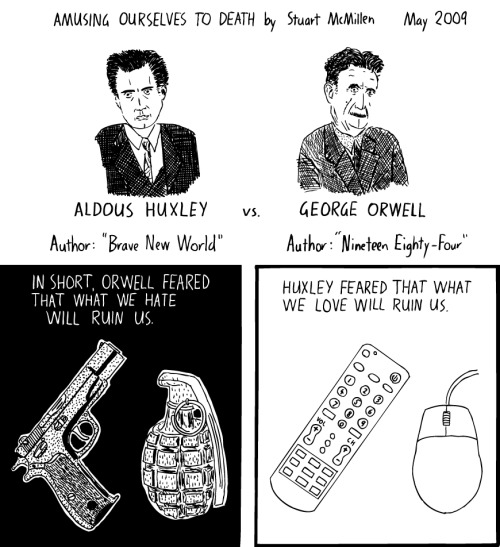
I don't think anyone really knows what the future will look like in thirty years. All we know is the genie is out of the bottle and nobody is going to put it back in.
Maybe we're headed for a dystopic corporatist future where everything is monitored, calculated and automated to such a degree that people are simply told what to buy at regular intervals. Mass acceptance will lead to computers dictating through goal posting, achievements and leaderboards the vast majority of each individual's lives.
Maybe we'll simply have 80% unemployment; towering concrete skyscrapers that would rival the soviet era Paneláks with automated trains sending food in and taking waste out. Like a human powered coal plant. The vast numbers of unemployed will churn daily riots and huge sections of the country will be under military control. There will be an unspoken but utterly clear separation between the decision makers and those in the bread lines.
Maybe we'll come up with entirely new sectors in biology, space and automation which will usher in the real space-age of humanity.
My hope: We'll make some breakthroughs in science, mathematics, medicine and technology. New sectors will be created that nobody ever thought of, a few new billionaires will be added to the pile, our quality of life will improve and the threat of our complete and utter demise will have been greatly exaggerated.